
Heronic: Redefining the limits of AI performance
Founder: Alex Montgomerie-Corcoran, CEO (Previously PhD Student, Imperial College London)
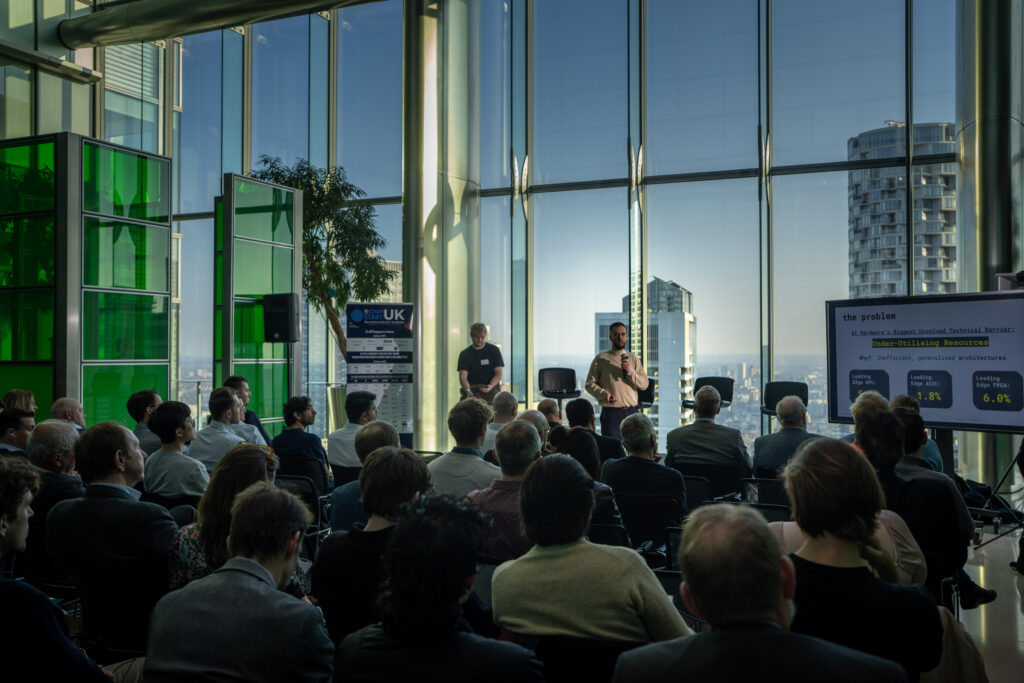
For many artificial intelligence applications, performance and efficiency are everything. Whether enabling a vehicle to react instantly to a road hazard or processing vast amounts of data for financial modelling – the underlying hardware is critical. While general-purpose chips like GPUs have been the workhorses of the AI revolution, a new venture from Imperial alumni is set to deliver a new paradigm in performance by creating bespoke hardware for specific tasks.
Heronic, founded by Dr Alex Montgomerie-Corcoran, is pioneering the automation of specialised AI hardware design. The venture was born directly out of a need Alex identified during his PhD research. “In order for myself and my colleagues to implement our research, we needed a way of rapidly designing high quality, efficient hardware,” he explains. “This tool became the main product for our venture.”
Instead of relying on pre-existing chips, Heronic creates entirely new chip designs tailored to specific AI workloads. This approach allows for significantly greater efficiency and performance, optimised for the exact task the AI is intended to perform. The impact of this innovation is already being felt. Heronic has achieved leading results for one of the MLCommons benchmarks, an industry-wide standard for measuring AI hardware performance.
The company’s potential has been recognised by key industry players. Heronic has won an award from the semiconductor giant AMD and secured a contract with a tier 1 semiconductor company to demonstrate its cutting-edge performance on Field-Programmable Gate Arrays (FPGAs). These are integrated circuits that can be configured by a user after manufacture – essentially a blank slate of digital circuitry that you can program and reprogram to perform a vast range of digital functions.
With $60,000 in revenue and a further £135,000 in grant funding already secured, the company is on a firm footing. This includes an Innovate UK grant that will fund the development of efficient hardware for super-resolution video technology for the next six months, with a view to pursuing wider commercial opportunities thereafter.
Reflecting on his journey, Alex credits the AI SuperConnector (AISC) programme with providing crucial support. The funding was instrumental, allowing the venture to purchase essential equipment, meet with potential customers, and finance a patent draft. Beyond the financial help, the cohort design was a key benefit. “The AISC community, specifically at Imperial, has been helpful for navigating the world of startups and discussing things specific to spinning out of Imperial,” says Alex.
By creating a platform to design the next generation of AI semiconductor devices, Heronic is not just building a company; it is aiming to redefine the limits of AI performance.
Success Stories

Heronic
An AI platform that simulates and optimises clinical trial designs to improve their speed and success rate.
Read more >

Nexus Additive
An AI-powered software platform to accelerate the validation and certification of 3D-printed medical devices.
Read more >
Cocreative Technology
An AI co-pilot for clinicians that listens to consultations and automatically generates clinical notes and administrative documents.
Read more >

Aleta Index
An AI-powered platform that predicts and helps mitigate disruption in pharmaceutical and medical device supply chains.
Read more >